Wednesday, September 28, 2011

Cuba at the 66th session of the UN General Assembly

Speech delivered by H.E. Mr. Bruno Rodriguez Parrilla, Minister for Foreign Affairs of the Republic of Cuba, at the 66th session of the United Nations General Assembly, New York, September 26, 2011.
 
Mr. President:

Allow me to congratulate you on your election.

We welcome the government of South Sudan for becoming the 193rd member of the United Nations.


I join the appeal by all African leaders to give an urgent response to the famine in the Horn of Africa

Mr. President:

While we are deliberating here in this hall, "another preventive" war is taking place in Libya using as a pretext "the protection of civilians". The United Statesand NATO, supposedly to avoid a massacre, launched a military attack against a sovereign State without there being any threat to international peace and security, and unleashed a "change of regime" operation.

NATO imposed on the Security Council a dubious resolution authorizing "member States... acting nationally or through regional organizations or arrangements... to take all necessary measures to protect civilians and civilian populated areas under the threat of attack."

Afterwards, NATO violated this same resolution in order to supply weapons, fund one of the parties to the conflict and deploy operatives and diplomatic personnel on the ground.

Now everybody has a better understanding of the concept of "responsibility to protect" and what it can be used for. In this war, waged with the most advanced and lethal military technologies, the means of communication have been used as combat weapons by the financial and media emporiums which are profiteering from the war and the reconstruction operations as if they were anti-crisis instruments.

As early as February 21, Commander in Chief Fidel Castro Ruz had warned that NATO was irremissibly preparing a war against Libya. Since then, Cuba engaged indefatigably not in the defense of a government, but of a principle: the assassination of thousands of innocent people with the dubious objective of protecting other civilians is something unacceptable. History has eloquently shown that peace can not be imposed either by war or by force. It is only up to the Libyan people to decide upon its destiny, without any foreign intervention, in the exercise of its right to self-determination and independence, its sovereignty over its natural resources and its territorial integrity.

The military intervention in Libya and the growing threat against Syria have been the opportunistic and defensive responses given by the United States and Europe to the collapse of their system of domination and plunder in Northern Africa and the Middle East, the emergence of genuinely popular movements in Tunisia, Egypt and other countries, in order to secure huge reserves of oil and water and confiscate financial assets in times of global economic and social crisis.

It is the task of this General Assembly to exercise its powers to prevent a military aggression against Syria. The public opinion should receive objective information and speak up against war. Mr. President: According to the Foreign Affairs magazine, the White House has rushed to describe what happened in that Northern African country as a model. It is said that the new US strategy is more efficient and less costly... that the Bush administration strategy considered occupation as an option ... that the Obama administration strategy is that of national liberation...that the military intervention strategy in Libya could also be applied in other cases." With full cynicism, reference is made to a military aggression without casualties or the use of infantry troops, the costs of which would be mainly borne by Europe. The destabilization of a country through subversion, covert operations and economic sanctions is described as the "development of a national movement".

This new "change of regime" operations model shows that the current US and NATO military doctrines are ever more aggressive than the previous ones, and that the so called "Euro-Atlantic periphery" comprises the entire planet. No one should doubt that Latin America and the Caribbean are included in that conception. The re-deployment of the Fourth Fleet, the installation of military bases and the sending of troops and military means to intervene anywhere in the region; the coup d'etat against Venezuela in 2002, followed by an oil coup; the sedition in Santa Cruz, Bolivia; the military coup in Honduras and the attempted coup in Ecuador fit perfectly well in the "new strategy".

Can the US and NATO give guarantees today that the use of force and this concept of "regime change" are not applicable in the case of the Latin American and Caribbean countries that do not yield to their interests? Can the European Union say something about it? What would the United Nations do in the event of such circumstances?

Mr. President:

The weakness of the global economy, particularly the economies of the United States and of the European Union, continues to show that the crisis that began in the year 2008 has not been yet overcome. In developed countries, the terrible burden of its consequences is borne by the workers, the unemployed, the immigrants and the poor, who are brutally repressed whenever they peacefully defend their rights.

We, the countries of the South, which are incessantly despoiled, are suffering the distortions of a world order that excludes our legitimate interests. We are suffering the terrible impact of protectionism and the steady increase in the prices of foodstuffs and hydrocarbons. The peoples of many developing countries are victims of worn out neoliberal economic models and their sequels of plunder and exclusion. The social and political consequences are being felt in all continents.

Mr. President:


In the face of a global economic crisis and the exhaustion of the natural resources of the planet, what would be the response of the extreme right wing forces that are in power or may reach power as a result of the punishment and hopelessness of voters?

In the face of a growing and universal threat of a war, a new distribution of the world and climate change, i,could we, the countries of the South, act together as an indispensable condition to save ourselves?

In the face of so many and serious threats, the Latin America and Caribbean region, the one that Bolivar and Marti fought for, is integrating and determined to finish what they left unfinished. It would be impossible either to divide us or to turn us against each other. ALBA is a small but morally powerful group of peoples and the new Community of Latin American and Caribbean States is already a fact.

The entire force of the Andes will very soon be expressed in a Summit that will be an epoch making event in Caracas, the epicenter of the independence of the Americas, where a Bolivarian people has conquered power and the stature of a continental leader, President Hugo Chavez Frias, is growing bigger.

More than ever before we have to defend the United Nations, but the biggest challenge would be to turn it into an organization that serves the legitimate interests of all States, instead of catering for the arbitrariness and abuses of a handful of rich and powerful countries. We must see to it that International Law as well as the Purposes and Principles of the UN Charter prevail in the face of the brute force that attempts to wipe them out. It is necessary to reestablish the leading role of this Assembly and relaunch the Security Council.

Mr. President:

The General Assembly has the inescapable moral, political and legal obligation to ensure the recognition of an independent Palestinian State, with the boundaries established before 1967 and with East Jerusalem as its capital, as a full member of the United Nations Organization.

If there's recognition of the inalienable right of the Palestinian people to independence, sovereignty and self-determination; if there is recognition of the need to reestablish the exercise of the human rights of Palestinians; if the blockade of Gaza, the economic coercion and segregation symbolized by the infamous wall are recognized as crimes; if the subjugation of a nation to conditions jeopardizing its existence is described as genocide; if all member States are supposed to adopt all legal measures within their reach to protect Palestinian civilians, then the General Assembly should take action now.

Cuba, a country with a small Jewish community, condemns the historical injustice of anti-Semitism, the crime against humanity which was the Holocaust, and recognizes the right of the State of Israel to exist. Our people only harbour fraternal feelings towards the Israeli people, who are also a victim of this conflict.

Cuba likewise proclaims that the United States has the moral, political and legal obligation to stop vetoing the Security Council resolutions destined to protect the Palestinian civilians.

The European Union should oppose this veto and abstain from supporting the empire's brutal pressure on the members of this Assembly and the Council itself. It should also be true and fair for Europe to denounce that those crimes would not be happening if not because of the military supplies, the financial support and the impunity ensured by the US to the Israeli government.

Mr. President:

On September 11, 2011, we Cubans shared the pain of the American people who were victims of those atrocious terrorist actions and offered our selfless solidarity, encouragement and cooperation. As usual, Cuba made some crystal clear statements against terrorism and against war.

Ten years after, the world is even more insecure because instead of turning international consensus against terrorism into a system of international cooperation to cope with it, the United States has invaded and occupied Iraq and Afghanistan, taking a toll on the lives of thousands of persons and causing pain to tens of millions.

Deception, torture, extrajudicial executions or assassinations, the disappearance of persons, arbitrary detentions and the CIA secret renditions and prisons in Europe and other regions were impossible to hide.

The US Government offends the memory of the victims of September 11 when it maintains the prolonged and inhumane imprisonment of the Five Cuban antiterrorists, who were unjustly sentenced to serve extreme sanctions at spurious trials for seeking information about the terrorist activities of the groups that have operated with absolute impunity from the US territory against Cuba, thus causing the death of or physical disabilities to 5 577 fellow Cuban citizens.

Once again, with all due respect, I urge President Obama to make use of his prerogatives to set them free as an act of justice or as a humanitarian gesture which will be highly appreciated by their children, wives, mothers, fathers and all of our people.

Mr. President:

The Cuban government reiterates its willingness and interest to move towards the normalization of relations with the United States. Today I reiterate the proposal of beginning a dialogue aimed at solving bilateral problems, including humanitarian issues, as well as the offer of negotiating several cooperation agreements to combat drug-trafficking, terrorism, human smuggling, prevent natural disasters and protect the environment, even in the event of oil spills as the one occurred at the British Petroleum platform in the Gulf of Mexico.


However, we know that the electoral race has already begun in this country while the economic situation is getting worse. The economic, commercial and financial blockade against Cuba has been tightened and the damages it has caused have totaled 975 billion dollars according to the present gold price. The attempts to subvert the constitutional order that Cubans have freely elected have intensified.

There are increasing pressures on the part of the extreme right and the Cuban American mafia to revert the minimal steps taken by the US government that, to some extent, favor the links between the Cuban emigres and their home country and the exchanges between both peoples. In Cuba, President Raul Castro has reiterated that we will continue to change, in a sovereign way, everything that needs to be changed so that our economy is more efficient and our socialism is better, in order to conquer "all the justice" and be able to fully preserve our independence.

As Marti said, "before ceasing in our endeavor to have a free and prosperous homeland, the South Seas will merge with the Northern Seas and a serpent will hatch out of an eagle's egg."
Thank you, very much.

Friday, September 23, 2011

Artists Collective


Y-art Sale
Rain or Shine!
Sept 24th &  25th from 10:00 am  to 3:00pm     
At: 18 Foxwood Crescent, Mineville


Terry Fox in Cuba

Thursday, August 18, 2011

NACLA REPORT

Current Issue

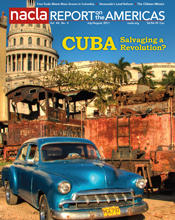
In this issue, we consider the new economic reforms announced by the Cuban leadership that aim to resuscitate a floundering economy that, as noted in the Introduction to the issue, “is incapable of producing the minimum supply of goods, services, and tax revenue needed to provide for the basic needs of the population.” What are the implications that Cuba’s new economy will have for social policy? How has the legacy of the Special Period in Cuba not only changed many Cubans’ attitudes toward their lives but also opened up new cultural spaces for expression and participation? What is the latest assessment of racial equality and gay tolerance on the island? Have U.S.-Cuban relations under the Obama administration been a case of missed opportunities for improvement? This issue of the NACLA Report on the Americas attempts to answer these important questions and more.

Taking Note

Suzanna Reiss
The United States imprisons more of its own citizens than any other country in the world, and in 2009 half of U.S. federal prisoners were serving time for nonviolent drug offenses. Unfortunately, the United States has exported this destructive model to Latin America through the drug war. Several recent reports and the hunger strikers at the Pelican Bay State Prison in California are now calling for a revision of these failed policies.

Updates

Kelly Nicholls and Gimena Sánchez-Garzoli
In April, President Obama and Colombian president Juan Manuel Santos reinitiated discussions on establishing a free trade agreement. The agreement had been on hold in the U.S. Congress because of grave concerns about Colombia’s labor and human rights record, but it is now scheduled to be implemented by the end of the year. The Colombian port city of Buenaventura will likely be one of the most directly affected places, at a very high cost to the local community.

Report

Eric Hershberg
In April, the Sixth Congress of the Communist Party of Cuba approved the most profound reforms that the island had seen since the 1960s. They are meant to revive the flagging economy. But are they sufficient? Will they succeed in reducing the hemorrhaging of state resources and increasing productivity, while enhancing social welfare? What will become of the thousands of laid-off public-sector workers? The jury is still out, and the answers to these questions will depend on the implementation of the reforms themselves.
Mayra Espina Prieto
Reforms proposed at the Sixth Communist Party Congress represent a new, third phase of social policy in post-revolutionary Cuba. This new stage has the potential to strengthen social equity in Cuba, improve the socio-economic situation of disparate social groups, and overcome the old limitations of social policy. Yet it could also increase inequality, and at least in the short term, its predicted impacts will be contradictory and ambivalent.
Katrin Hansing
The continuing economic crisis in Cuba has not only changed many Cubans’ attitudes toward their lives but has also opened up new cultural spaces for expression.
Armando Chaguaceda
In the face of inadequate Cuban state policies of citizen participation, autonomous groups are emerging from society, in hopes of greater citizen empowerment.
Armando Chaguaceda
In recent years, pro-revolutionary but generally anti-bureaucratic groups have emerged in Cuba. One of the more prominent is the Protagonistic Critical Observatory Network, an alliance of collectives representing a broad spectrum of left-wing political positions—together with artistic endeavors, environmentalism, spirituality, and opposition to gender and racial discrimination.
The Protagonistic Critical Observatory Network
On April 29, the Protagonistic Critical Observatory Network (Red Protagónica Observatorio Crítico), an autonomous group of Cuban activists and intellectuals, received the following invitation via e-mail from the U.S. Interests Section in Havana.
Marguerite Rose Jiménez
After significant investment and a slow entry into international markets, Fidel Castro’s “billion dollar gamble” on the home-grown Cuban pharmaceutical industry now seems poised to pay off.
Alejandro de la Fuente
Despite fragmentary data, several studies have shown that racial inequality has worsened in Cuba since the 1990s. Anti-discrimination policies, at a minimum, seem necessary if the Cuban revolution is to salvage its anti-racist legacy.
Noelle Stout
In November 2010, a UN vote ignited a public controversy on the island, as Cubans accused government leaders of failing to protect the rights of gay people. The controversy also illuminated the changing role of post-Soviet civic society in creating government policies toward sexual minorities.
William M. LeoGrande
It once appeared as if President Obama were proceeding toward a new Cuba policy. He ended restrictions on Cuban American remittances and family travel to Cuba, as promised. Havana was receptive, but there were dark clouds on the horizon.

Wednesday, June 22, 2011

Summary of News from Cuba

  • Cuban General Comptroller’s Office: The role of Managers and Staff in ensuring Internal Control
HAVANA, Cuba, June 20 (acn) Cuban General Comptroller Gladys Bejerano Portela told the weekly newspaper Trabajadores that management boards and staff are responsible for ensuring internal control in any Cuban enterprise.

Bejerano Portela, who is also vice president of the Council of State, recognized that most people holding administrative posts are hard-working and took the leadership of Cuban enterprises in difficult times but they may lack training and skills and can be influenced by dominant practices -such as a focus on production “no matter the means and costs.” Numbers are important, she said, but quality and good results are also vital. 

The Comptroller’s General Office has detected cases in which people have failed to fulfill their duties, but there are also enterprises boasting high production levels even if there are irregularities due to the lack of control. Education and training about these issues is crucial and relevant not only to the administrative boards but to staff, said Bejerano Portela. The General Comptroller’s Office plays an important role in updating the Cuban economic model; its mission is preserving the country’s resources by ensuring efficient economic and administrative management and preventing corruption and illegalities.

  • Washington: Over $20 Million earmarked for the new subversion project against Cuba  
HAVANA, Cuba, June 20 (acn) The U.S. Agency for International Development (USAID) has released details of a new $21-million subversion project against Cuba targeting adolescents and youths between the ages of 12 and 24 years, aiming at interfering with social media in the Caribbean nation.

Tracey Eaton in her article investigating how Washington spends millions of US taxpayers’ dollars in “illegal and covert actions against Cuba” published in http://cubamoneyproject.org. describes the program’s objective as “to increase opportunities for youth-to-youth interaction in Cuba, allowing the country’s young citizens to experience freedom of association and freedom of expression in social spaces organized outside state authority.”

Of the $21 million, $6 are earmarked for “programs aimed at increasing free expression among youth ages 12 to 24”, another $6 are to be used "expanding Internet use and increase access to information;” and $9 are to be spent “supporting neighborhood groups, cooperatives, sports clubs, church groups and other civil society organizations.”  Eaton recalls that on April 1, Sen. John Kerry, D-Mass., held up distribution of $20 million in deemed “democracy funds” for Cuba over questions about how the money was to be spent. The Miami Herald later reported on June 10 that the extreme right-wing anti-Cuba organization Freedom House was returning $1.7 million in funds because USAID asked too many questions about where the money was going.

Phil Peters, a Cuba expert at the Lexington Institute -a research organization in Arlington, Virginia, told Eaton that it is unusual for organizations to return money to the federal government. It is “certainly understandable” that Freedom House is “extremely concerned” about protecting those people connected to its Cuba program, he said, “but if you step back from it, the group’s decision to return the money really reinforces that it carries out political operations in Cuba."
  • UN Recognizes Cuba’s Efforts and Results against Racism
HAVANA, Cuba (acn). Representatives of the UN recognized the efforts and advances of Cuba in the struggle against racist discrimination on Thursday (June 16).

Rolando Garcia, representative of the UN Population Fund, told Granma newspaper that Cuba is the leading country in Latin America regarding equal opportunities for all citizens. “These advances match the inclusive and participatory policies promoted and implemented by the Cuban State,” he added. “We can affirm in the case of Cuba that it solved the main problems of discrimination and managed to integrate everyone into society,” said Garcia. He was participating in the seminar “Cuba and Afro-Descendant Peoples in the Americas” at Havana’s Juan Marinello Cultural Research Institute.

Juan Jose Ortiz, representative in Cuba of the UN Children’s Fund, said that thousands of Afro-descendant children in the region suffer extreme poverty and its consequences. “However, thanks to the political will of the Cuban government, none of them lives in Cuba.” Ortiz also highlighted that Cuba and Norway are the countries with the lowest infant mortality rate in the world, and particularly extolled the results attained by Cuba in this regard considering that it does not have the same development and riches Norway has. Barbara Pesce, the resident coordinator of the United Nations System in Cuba, also pointed out that Cuba is an example in the struggle against racial discrimination.
  • Scorpion Breeding for Medical Purposes in Cuban Province
Ciego de Avila, Cuba, June 20 (Prensa Latina). The breeding of scorpions in captivity is moving forward as part of a national program to increase the production of medicine for treating cancer. Specialists of the Pharmaceutical Biological Laboratory (LABIOFAM) in Ciego de Avila extract venom from the Rhopalurus junceus scorpion, between 900 and 1,000 mL of the toxin are obtained monthly and sent to LABIOFAM in Havana for processing.

Each specimen can provide about 5 drops explained Madelin Hilacha, a quality control technician at the centre. The scorpions, captured from rocky, damp areas, especially in the cays north of Ciego de Avila, she explained, are classified and kept in containers with necessary water and food for about two years and then returned to their natural habitat.

The anticancer effect of their venom, discovered 20 years ago in Guantanamo, prompted more detailed research. The toxoid obtained from the scorpion venom has benefited thousands of Cuban and foreign patients (from Europe and Latin America) in the treatment of lung, breast, uterus, colon, prostate and pancreas cancer. The toxoid has also been shown to have analgesic and anti-inflammatory effects.

  • Restoration: U.S. expert lauds Cuban Professionalism
Havana, June 19 (Prensa Latina) U.S. restoration expert Walter Newman, director of paper conservation at the Northeast Document Conservation Center in Andover, Massachusetts, lauded the professionalism of the Cuban experts with whom he has collaborated since 1996 to restore and preserve national heritage.

"It has been a privilege to work here during all these years and I hope this cultural exchange will continue," Newman told Prensa Latina. "Cubans are very well prepared, they are very hardworking and dedicated" said Newman, one of 95 participants at the 13th International Colloquium on Ernest Hemingway at the Ambos Mundos Hotel in Havana. He feels lucky every time he is able to travel to Cuba, and regrets that the U.S. blockade of over 50 years against Cuba hinders bilateral exchange. "I feel privileged to be here."

Newman has coordinated the restoration of Hemingway's legacy at the Finca Vigia museum for several years. Cleaning and repairing papers damaged by the passing of time has been a difficult task that he has undertaken with great dedication. Newman has worked on manuscripts, letters, notebooks, books with corrections and personal documents that belonged to the author of The Old Man and the Sea. He also works daily on other patrimonial works of the US and the world, including engravings by Dutch painter Rembrandt and Spanish painter Pablo Picasso, and documents on the history of U.S. baseball kept in the Hall of Fame in New Cork.

·        Germans Protest US Blockade against Cuba

Berlin, June 19 (Prensa Latina) Hundreds of activists with the Cuba solidarity movement in Germany demonstrated outside the Brandenburg Gate to protest the US economic, commercial and financial blockade imposed on Cuba for over 50 years. The rally, under the slogan "50 Readings against 50 Years of Blockade," was organized by the Berlin-Cuba Friendship Association.

"We chose a centrally-located site in Berlin, the Pariser Platz (Paris Square), frequented by many people who go for a walk there, to tell people about Washington’s policy against Cuba," an activist told Prensa Latina. The Pariser Platz is located just between the Brandenburg Gate and the U.S. Embassy. The Berlin-Cuba Friendship Association carried out a similar action in 2001 on the 40th anniversary of the U.S. blockade against Cuba. This time, 50 well-known individuals and friends of Cuba read articles, essays and poems to express their rejection of the U.S. blockade.


·        Brazilians Reaffirm Solidarity with Cuba

Rio de Janeiro, June 19 (PL) Participants in the 6th Cuba Solidarity Conference approved an action plan to step up solidarity with the Cuban Revolution. The struggle to end the U.S. economic, commercial, financial blockade imposed on Cuba for over half a century and the immediate release of the Cuban Five -anti-terrorist Cuban fighters unjustly held in U.S. prisons, were the focus of proposals made during the event.

More than 100 Rio residents representing political parties, social, labor and peoples’ movements and the Association of Cuban Residents in Brazil, attended the two-day event held at the teachers’ union headquarters in Rio de Janeiro. Zuleide Faria de Melo, president of the Jose Marti Cultural Association and one of the organizers, extolled the example and dignity of the Cuban people in maintaining their Revolution undefeated, just 90 miles away from the United States.

Participants agreed to encourage the use of alternative media to help spread Cuban media reports and raise awareness about the cause of Gerardo Hernandez, Antonio Guerrero, Fernando Gonzalez, Ramon Labanino and Rene Gonzalez, internationally known as The Cuban Five. They also agreed to join an on-line global campaign on the 5th of every month, and to encourage people to take out a subscription to the Portuguese-language version of Granma International weekly to better understand Cuban and world reality.

There will be a monthly program of events in public centers, schools and universities to counteract the media campaign against the Cuban Revolution and the Cuban and letters sent to the Cuban heroes and, messages to U.S. president Barack Obama, the U.S. government and Congress. The Action Plan will be presented by the JMCA of Rio de Janeiro to the National Cuba Solidarity Conference in Sao Paulo on June 23-26, 2011.


  • July Event: Cuba Hosts Disaster Risk Assessment Conference
Havana, Jun 19 (Prensa Latina). The 3rd International Colloquium on Assessments of Hazard, Vulnerability and Risks for Disasters Reduction will take place in Cuba July 6-8. The Colloquium is part of the 8th International Convention on Environment and Development, opening on July 4 at the Havana Convention Center, includes conferences on protected areas, climatic change, ecosystems, biodiversity, education and environment and two colloquiums on environmental rights and environmental order. An exhibition fair will also be held for institutions and organizations to present technology, projects and experiences.

International specialists, academics, managers and people involved with natural, technological and sanitary hazards will exchange experiences on disasters reduction. The event will especially focus on the effects of climatic change, tropical storms and other extreme events, regression of the shoreline, drought, forest fires and other threats to small island states and coastal ecosystems. It includes lectures, panels, roundtables and poster sessions. Cuban specialists will present their experiences regarding the erosion of Cuban beaches, mangroves as protection against natural disasters, and the use of multiple-danger maps for disaster risk studies, among others.


Marathon of Hope in Cuba
·        Cuba Mourns Betty Fox

Havana, June 18 (Prensa Latina). Betty Fox, the mother of Terry Fox, died Friday June 17 in a health center of Chilliwack, BC, Canada. Betty has been an icon in the fight against cancer. In 2010, Betty, her husband Rolland, and her daughter Judith Fox-Alder (president of the Terry Fox Foundation) were present at the Terry Fox Run in Cuba, an immensely popular annual event. The run, organized by the Cuban Sports Institute (INDER), has been held every year since 1998.

Terry Fox, a national hero in Canada, was a bone cancer survivor whose leg was amputated when he was 18 years old. In 1980, he began running a "Marathon of Hope” to raise awareness and money for cancer research. Terry died at the age of 22 and his mother remained active in the fight against cancer and including Terry Fox Runs all over the world.  

Tuesday, April 5, 2011

Jimmy Carter: Lift Trade Embargo Against Cuba

By Peter Kornbluh
The Nation


“I hope we can contribute to better relations between the two countries,” Jimmy Carter said describing his mission in visiting Havana this week. At a remarkable press conference as he left to return to the United States today he issued a powerful, resounding, call for major changes in US policy toward Cuba.
Briefing reporters at the Palacio de Convenciones in Havana, Carter touched on virtually every key aspect of US-Cuban relations: the embargo, the case of imprisoned AID contractor Alan Gross, the Cuban Five, Cuba’s inclusion on the terrorism list and the need for greater freedoms—not only for Cubans but for American citizens who are restricted from traveling to the island.
“I think one serious mistake that my country continues to make is the trade embargo,” Carter stated bluntly. The economic restrictions on commerce were “damaging to the well-being of every citizen in Cuba,” and “impeded rather than assisted” reforms that he hoped would be made on the island under Raul Castro’s leadership. “We should immediately lift the embargo,” Carter said, as well as all restrictions on travel to Cuba.
When the Carter trip was announced last week, many analysts believed he intended to bring imprisoned AID contractor Alan Gross back to the United States. Arrested in December 2009, Gross was prosecuted and convicted earlier this month for illegally distributing satellite communications gear to religious groups inside Cuba—part of a US government “democracy-promotion” program intended to undermine the Cuban regime. According to State Department officials, his arrest, conviction and sentence of fifteen years in prison has become a major stumbling block in improving US relations with Cuba.
But Carter made it clear that the Cuban government had warned him in advance not to expect Gross to be freed at this time. After visiting Gross at an undisclosed location this morning, Carter addressed the need for him to be released “because he is innocent of any serious threat to the Cuban people.” Gross’s conviction should be overturned by Cuba’s Supreme Court on appeal, Carter forcefully opined, or Raúl Castro should pardon him, or soon release him to his family on humanitarian grounds.
In perhaps his boldest—and riskiest—statement as a former US president, Carter also called for the release of the so-called Cuban Five, a handful of Cuban counterterrorism agents arrested by the FBI and convicted of spying against violent exile groups and other US targets in 1998. Carter noted that the five agents had been in US prisons for more than a dozen years and characterized their further incarceration as “unwarranted.”
In response to a question posed by The Nation about why Cuba remains on the State Department's list of nations that support terrorism, Carter was unequivocal: Cuba’s inclusion on the list was “completely unfounded” and based on “untrue allegations” that Cuba was harboring international terrorists from the FARC in Colombia and separatist Basque group ETA from Spain.
Indeed, to build a case to take Cuba off the list, Carter met in Havana with diplomats from both Spain and Colombia who said they welcomed Cuba’s policy of accepting the FARC and ETA members, as it facilitated communications between those groups and those governments. In a significant revelation, Carter told the press that US and Cuban intelligence were currently “cooperating” in counterterrorism efforts against Al Qaeda. “I think we should take Cuba off the terrorism list,” Carter stated bluntly.
Accompanied by his wife, Rosalyn, American University professor and former Carter White House aide Robert Pastor, Dr. Jennifer McCoy, director of the Carter Center’s America’s program, and Dr. John Hardman, president of the Center, Carter’s three-day trip was skillfully organized to give him maximum credibility as well as substantive political cover in pressing for changes in relations on both sides. Repeatedly during the press conference he called for respect for human rights and full freedoms for the Cuban people. This morning he met the internationally popular Cuban dissident blogger Yoani Sánchez as well as the recognized human rights activist Elizardo Sánchez Santa Cruz. Monday he visited Cuba’s only Jewish community center in Havana. During his three days in Cuba, he also conferred  with diplomats from other nations who have full relations with Havana. In a remarkable gesture to the importance the Cuban government attaches to the case of the Cuban Five, Carter visited two mothers and three wives of the detained Cuban agents.
This morning Carter met with Fidel Castro, whom he characterized as “an old friend.”
But his most important meeting was Tuesday night with Cuban President Raúl Castro. The six-hour summit started with chit-chat in a salon of the Palacio de Convenciones, and then moved to a relaxed dinner at Café del Orient—one of Cuba’s pre-eminent restaurants. After dinner, Castro was seen walking Carter and his wife back to their hotel in Old Havana. In a significant gesture, President Castro bid Carter goodbye at the airport, and told the press that he was sending a message to Obama with him that Cuba desired normal relations with Washington—as equals and without conditions.
In 2002 when Carter became the first and only former US president to visit Havana, he briefed President George Bush when he returned. (Bush tightened restrictions on travel as he began his 2004 re-election bid, and essentially called for the Cuban people to rise up and overthrow Castro.) Today Carter made it clear that he would be briefing President Obama on this trip as well and would suggest to him a variety of steps the president could take to improve ties. He noted that there would be “confidential matters” he would discuss with Obama, inferring that there were back-channel aspects to his meetings with Cuban President Raúl Castro.
Shortly after his inauguration in 1977, Carter issued a secret presidential decision memorandum on changing Cuba policy. “I have determined that we should attempt to normalize our relations with Cuba,” it stated. “When I was president I did the best I could to improve diplomatic relations,” he recalled, although his administration never achieved the full rapprochement with Cuba he envisioned. More than three decades later, Jimmy Carter remains clearly committed to that elusive goal.
 

Sunday, February 20, 2011

New Housing Construction in Isla de la Juventud

Postcard from a recent visit by NS Cuba member and CUPW retiree Ruth Larson:

My first visit to the Isla de la Juventud was in 1996 and I have gone there many times since. It is Cuba’s largest island and is 2200 square kilometres. The capital is Nueva Gerona where marble hills can be easily spotted. This island has no sugar cane but is known for citrus fruits and marble. The locals sigh when they hear of Isla de la Juventud, “Ahh, La Isla es muy bonita”.

“La Isla” is the least populated region of Cuba. Gerona has a population of about 14,000 and La Fe about 9000, and people are scattered amongst the small farms and towns. Scuba diving along the ‘Pirate Coast’, Indian cave paintings at Punta del Este, Presidio Modelo built under Batista, capable of holding 6000 prisoners and where Fidel was once imprisoned; the black beach and unspoiled coral keys are some of the highlights of this island.

Getting there is for the adventurous! Cubana flies an Anatov aircraft from Havana to Nueva Gerona a few times a day; it is a 30 minute flight. As well, there is a hydrofoil that takes about two hours and leaves from a port near Havana.

Casa Particulares are a good option and food is good; as well, there are a few small hotels nearby.
Horse and cart and bicycle taxis are still important modes of transportation.

Hurricanes have caused devastation to homes and crops over the years. On my last visit two years ago, I saw the devastation caused by the most recent hurricane with roofs destroyed, crops uprooted, the local post office destroyed and the roof of the stadium completely gone. We watched a baseball game, shaded by umbrellas from the hot 30 degree sun! The latest visit in 2011 allowed me to see the determination of the Cubans on La Isla with the construction of new homes in Sierra Caballo, near Gerona, built with aid from Venezeula (these are typical models built by the state in Venezuela).  In Gerona there were other homes being constructed.

People on the Isla are easy going and friendly. I have friends whom I met on my first visit in 1996. I have been to the Isla about 25 times over the years, including once on May Day; La Isla is nearly always on my list of “things to do in Cuba”.

Enjoy the photos!

Ruth Larson

New Housing Construction: Venezuelan Aid


Sunday, December 5, 2010

Canadian-Cuban artists exchange art and culture

Three Cubans recently spent six weeks in Nova Scotia teaching and learning about Nova Scotia art and culture.  Although the two Cuban artists spoke little English, through a translator Heriberto Acanda Ramos said, "Culture has no language."

Mr. Acanda was accompanied by fellow artist Raúl Jesús Garcia Hernández and cultural centre manager Mayda Hernández Morejón. The group brought 20 pieces of art from their home in Pinar del Rio. The pieces were on display at the Lunenburg Art Gallery and at Pier 21 in Halifax.

The Nova Scotia and the Pinar del Rio cultural exchange began in 2003 when Lunenburg County artist Ruth Wilton hosted a Cuban supervisor through the Canada World Youth Project. After developing a friendship, Ms Wilton and her husband visited Cuba in 2004. During their stay, they met with Ms Hernández Morejón and the idea for the art and culture exchange resulted.

Read more at South Shore Now

Friday, October 29, 2010

Farmers Tour of Cuba!

Canada-Cuba Farmer to Farmer Project

Winter 2011 Farmer Exchange
BOOKING DEADLINE NOVEMBER 15th

Three days of sun and luxury on Cuba's beautiful Varadero Beach / Eight days of travel through Cuba's countryside visiting large cooperative farms / Three days in Old Havana


Farmers: this tour is deductable as a business expense!