
Six Months after the Earthquake: Time to Build Public Health Care in Haiti
July 29, 2010--In the six months since the deadly earthquake struck Haiti, MEDICC and its partners have launched multiple initiatives to support long-term health care provided by hundreds of doctors on the frontlines in clinics and hospitals across the country. These are young graduates from Haiti and the region trained at Havana’s Latin American Medical School, joining over 350 Cuban doctors and other health professionals to dramatically increase access to health care for all Haitians by building a system of public health services.
Full Story at MEDICC.org
Wednesday, August 4, 2010


Thursday, July 29, 2010
A key reference on Cuban doctors abroad programmes
Cuba is rarely assessed objectively by external critics, typically being viewed through leftover Cold War filters or dismissed as an anachronism for its continuing effort to make socialism work. This book provides an excellent survey and analysis of Cuba's deeds in the international arena of health care, disaster relief and South-South cooperation. Kirk and Erisman effectively answer those critics who see Cuba's international medical programme as having foundations in the economic crisis of the 1990s (i.e., selling medical services to keep the money flowing) and instead provide a comprehensive historical accounting of Cuba's assistance to the developing world.
The case is effectively made that Cuba's global health initiatives arise from a commitment to solidarity rather than any profit motive. Of particular interest is the revelation that in situations where Cuban military or technical support has been requested (Algeria, Angola, Congo, etc.), the Cubans ensured that medical and educational staff were significant components of any agreement. One looks forward to a followup study on Cuba's activities in Haiti, as this book was published before the January, 2010 earthquake. Cuban assistance to Haiti pre-dates the disaster by a decade, and is a prime example of the enduring benefits Cuban assistance provides: Cuba's medical teams were on the ground when the quake struck, were and continue to be the largest single medical team working on the island. This is development in practice, rather than empty words.
Important note: The authors of this book are generously donating all profits to the MEDICC programme that supports the Cuban medical effort in Haiti.
Important note: The authors of this book are generously donating all profits to the MEDICC programme that supports the Cuban medical effort in Haiti.
Tuesday, July 27, 2010
Spoken Word Performance by El Jones: MONCADA
MONCADA
By El Jones, Halifax, Canada, July 23, 2010
I am the weapon fired in the Barracks at Moncada
I am the first blow struck for liberty in the resistance
I am the raised fist and the heroism of the martyr
I am not a rifle, shotgun or pistol. My ammunition is
The ideal of equality sown in the minds of the parking lot attendants
Delivery boys, chauffeurs and street vendors
The 25 rebels raised without fathers
The legacy of oppression felt in every ghetto
From Rio de Janeiro to Harlem
I am the bullet in the chamber loaded in Santiago
In the speeches of Eduardo Chibas
And broadcast in the barrios on the people?s free radio
I am Viva La Cuba Libre in embryo
Spoken in Spanish and Creole and
Stoked in poverty and broken homes
Until it was shown in growing whispers among the youth
On the streets and in universities
I am the truth and the grassroots marching in the boots
From day labourers to Che Guevara
I am the ancestral memory of the sugar cane fields
The machete passed from the hands of Toussaints warriors in Haiti
To the Cuban sugar workers labouring in the heat
I am snatching victory out of the jaws defeat
I am the speeches written from the prison cell
And the spit in the eye of the torturer
I am Fidel?s courtroom testimony
When I descend I strike a blow for solidarity
I am the revolution waged since 1492
Begun in the resistance of indigenous Taino and Arawak
And sustained in their descendents
Labouring in tobacco plantations
I am embargo and self-sustaining
I am guerilla tactics learned on the 26th of July
I am the absolution of history
I am the ongoing battle for independence from
The American attacks from 1906 to Guantanamo occupation
My echo has been felt from Palestine to Iraq
In every national struggle for liberation
I am the refusal to bow to imperialism
I am the destruction of class division
I am the 300 million of the people?s money Batista carried into exile
I raise fists against corruption I march miles
For the people?s rights I am the general strikes
I am the shot fired across the color line
For the mulattos and Afro-Cubanos
The shades not light enough to work in hotel cabanas
I am the legacy of slavery and African birthright
Whose beat runs through the salsa and mambo
I am the spirit of Baba Shango
I put the heat in the cold war
I am street festivals and the resistance of the poor
I am the redistribution of land and local ownership
I am nationalization of industry, collective agriculture and public education
I am the constitution that says the people own the nation
I am the belief that rice and peas served to all people
Tastes sweeter than steak served to the elite
The shots I fire are completed in Cuban doctors
Saving earthquake victim and free health care
Extended across the Caribbean
I am brown and black people?s freedom
I am the troops sent to Angola to fight South African apartheid
I am asylum offered to Asata Shakur and political exiles
The blows I strike have been felt from Bolivia to Venezuala
I am the coca farmers and the baseball players
And the peasants fighting oil corporations in the Amazon basin
I am the battle for land repatriation and slave reparations
The Caribbean workers in the free trade zones sewing sweatshop labels
I am the union organizers on Dominican sugar Bateys
The squatters rights and transnationalization of indigenous populations
The indigenous confederations fighting from Brazil to Peru
I am the Cuban revolution
And I will survive beyond Castro
Because I am the shot fired in the name of equality by heroes and martyrs
I am Moncado, I am Havana,
I am the ideal that thrives in the minds of the people
I am liberation.
Friday, July 16, 2010
MONCADA DAY COMMEMORATION - VICTORIA PARK, HALIFAX
Friday, July 23rd from 3:00 pm - 5:00 pm
Victoria Park (Spring Garden and South Park), Halifax
July 26, 2010 will mark the 57th anniversary of the act that is annually celebrated all over Cubaas the beginning of the movement and struggle that paved the way for the Cuban Revolution. On that day 57 years ago, Cuba's rebels rose up against the dictatorship of Fulgencio Batista. Although that first battle was lost, the Revolution ultimately prevailed.
On July 23, we gather to remember and honour those that were lost on that day, and to celebrate Cuba's independence. There will be performances from noted Nova Scotian jazz artist Jeff Goodspeed (director of famous youth music group Los Primos), El Jones (acclaimed spoken word artist), and more!
This is a free event organized by the Nova Scotia Cuba Association.
Monday, May 24, 2010
Cuba's 2010 Municipal Elections: article by Arnold August
Read this in-depth report of the recent municipal elections in Cuba. The author offers a detailed look into the structure of local Cuban democracy -- excellent reading for those that do not know a great deal about the structure of participation in Cuba.
The Elected Delegate and the Dissident in Cuba's Municipal Elections
The Elected Delegate and the Dissident in Cuba's Municipal Elections
Saturday, May 15, 2010
CNC Honours Cuba's Dreamcatcher Role in Haiti
On May 5, 2010 a moving ceremony was held in Havana, Cuba to mark the continuing success of the Canadian Network on Cuba (CNC)'s Cuba For Haiti Campaign. The campaign, launched in January 2010 in response to the earthquake disaster has thus far raised nearly $100,000 to support the Cuban Henry Reeves Medical Brigade in Haiti. Participating in the event, held at the headquarters of the Instituto Cubano de Amistad con los Pueblos (Cuban Institute for Friendship with the Peoples - ICAP), were Raciel Proenxa Rodríguez, Director of Economic Cooperation, Ministry of Foreign Commerce and Investment, Isaac Saney, Co-Chair and National Spokesperson of the CNC, officials of ICAP, members of the Canada-Cuba solidarity movement and Haitian youth studying in Cuba.
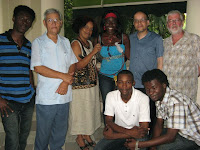
Proenxa thanked the CNC for its contribution and explained where the money is being spent. At the time of the earthquake in Haiti, 402 Cuban internationalists, 302 of them medical personnel, had already been helping Haitians, Proenxa pointed out. Since the earthquake, he explained, Cuban cooperation has grown to 1,304 persons, with 679 Cubans, and 625 graduates and students from 26 other countries, trained and educated free of cost at Cuba's Latin American School of Medicine. He further noted that as of May 4, 2010, 330,306 patients have been treated, with 8,428 surgeries performed. Proenxa emphasized that Cuban assistance encompasses more than just the provision of immediate medical attention. It is now also focused on strengthening and rebuilding the Haitian healthcare system. Toward those ends, the Cuban medical and paramedical internationalists work in 56 hospitals and healthcare centres, and have installed and equipped 30 rooms, in which 85, 401 patients have been treated.
 On behalf of the CNC, Saney stressed that the Cuban internationalist mission not only assists the Haitian people at a time of great need, but underscores the magnitude of the island's generosity and national altruism. In this regard, the success of the Cuba for Haiti Campaign lies not only in the money that has been raised but also in the possibility it offers to participate in a truly humane solidarity project, Saney said. Saney recalled that in 1998 at a meeting between then Canadian Prime Minister Jean Chrétien and Cuban President Fidel Castro, the leader of the Cuban Revolution proposed a joint Cuba-Canada cooperative project to rebuild the Haitian healthcare system. Cuba could provide the personnel and Canada could contribute the material resources required, Castro pointed out. Even though Chrétien ignored the proposal, the CNC decided to take it up, Saney said. The fundraising for Haiti via the Cuban internationalist mission has been very warmly received by Canadians, he said. Despite being ignored by the Canadian monopoly media, the campaign demonstrates the confidence that the Canadian people have in Cuba, he added. He pointed out that some of the contributions have been given by people simply on the grounds that if the money they want to give to Haiti goes through Cuba, they feel confident it will safely reach its destination and not be squandered in corruption or misused. This shows the respect and admiration of Canadians for the Cuban people and their efforts to build and defend a society centred on independence, justice and human dignity, Saney said.
 Saney concluded by presenting Proenxa with a dreamcatcher made by the Mi'kmag people of Nova Scotia. Dedicated to the Henry Reeves Medical Brigade, Saney noted that just as the dreamcatcher allows only good dreams to pass through while destroying nightmares, so too the Cuban medical and educational internationalist missions stop the nightmares of disease and illiteracy from reaching the people, while demonstrating the alternatives which permit people to realize their deepest aspirations, and that another better world is possible.

Proenxa thanked the CNC for its contribution and explained where the money is being spent. At the time of the earthquake in Haiti, 402 Cuban internationalists, 302 of them medical personnel, had already been helping Haitians, Proenxa pointed out. Since the earthquake, he explained, Cuban cooperation has grown to 1,304 persons, with 679 Cubans, and 625 graduates and students from 26 other countries, trained and educated free of cost at Cuba's Latin American School of Medicine. He further noted that as of May 4, 2010, 330,306 patients have been treated, with 8,428 surgeries performed. Proenxa emphasized that Cuban assistance encompasses more than just the provision of immediate medical attention. It is now also focused on strengthening and rebuilding the Haitian healthcare system. Toward those ends, the Cuban medical and paramedical internationalists work in 56 hospitals and healthcare centres, and have installed and equipped 30 rooms, in which 85, 401 patients have been treated.


Thursday, May 6, 2010
Cuba rated best place to be a mother
Cuba provides the best conditions for motherhood among developing countries, according to Save the Children's State of the World's Mothers 2010 report.
The report, made public Monday, examines 160 countries - 43 developed and 117 developing ones - and analyzes the best and worst places to be a mother based on 10 factors such as the educational status, health, economic circumstances of the mothers, as well as the basic well-being of children.
Read the story at Times of India
Download the report from Save the Children (PDF 3.8 megs)
Tuesday, April 20, 2010
Saturday, March 27, 2010
Truro resident cycles Cuba

Bob Williams loves an adventure. Having recently returned from a 800 km bike ride around Cuba, he hopes to chase the warm weather north this spring with a ride up the eastern coast of the U.S.
Published on March 26th, 2010
David Archibald
Truro resident cycles Caribbean island
Subscribe to:
Posts (Atom)
