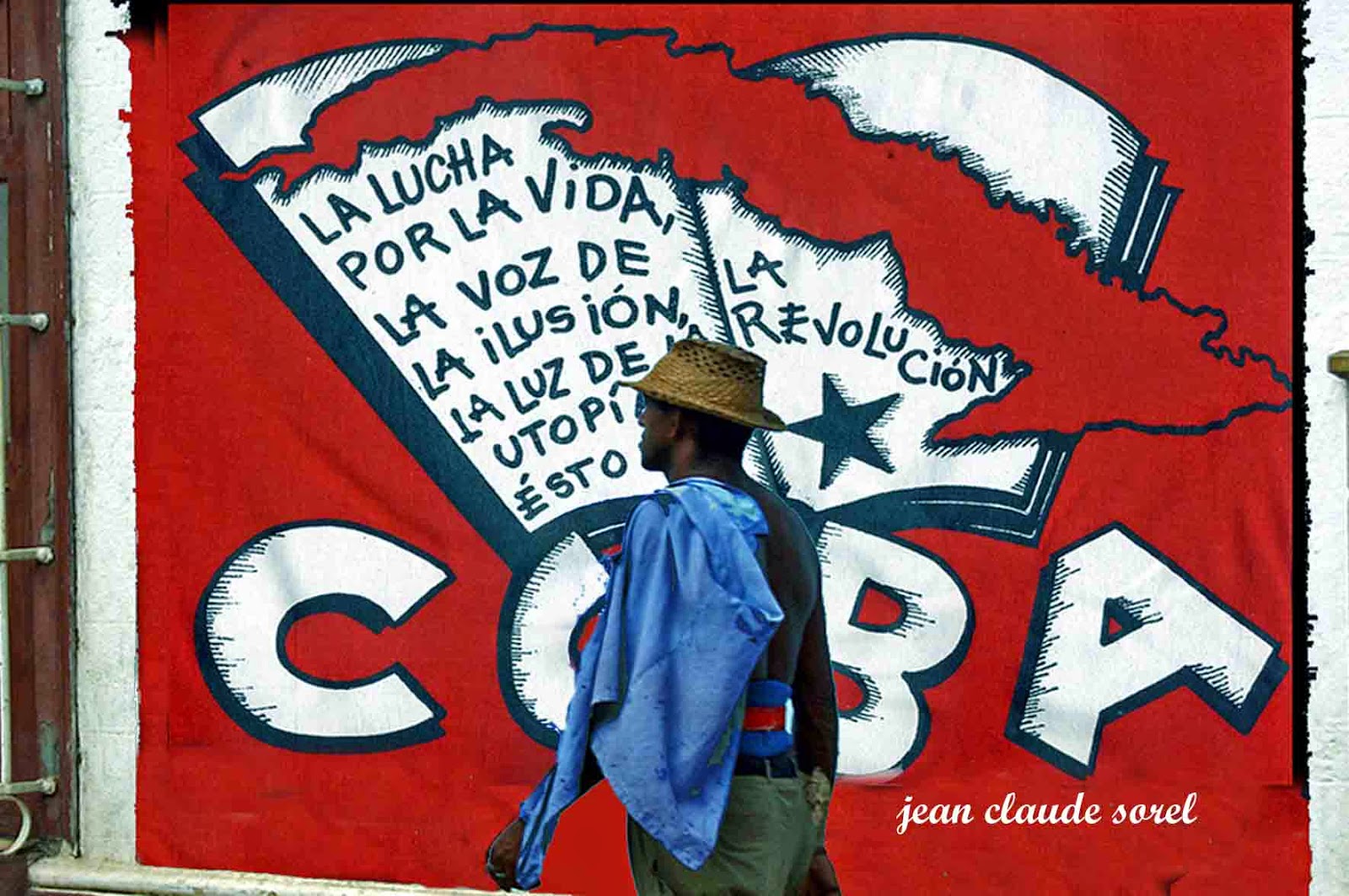
On the occasion of his 89th birthday, the Canadian Network On Cuba sends its heartfelt congratulations to Fidel, the historic leader of the Cuban Revolution. It is deeply humbling to have lived and witnessed Fidel's uncompromising and indefatigable dedication to justice and human dignity.
On October 16th, 1953, in the wake of the heroic Moncada revolutionary action, Fidel declared, "History Will Absolve Me."
History has not only absolved but also vindicated Fidel!
This vindication is crystallized in the triumph of the Cuban Revolution. On January 1st, 1959, the Cuban people under the leadership of Fidel took control of their country and destiny. Their successful resistance of the empire is the concrete reflection of the principled and dignified politics and leadership of Fidel.
No words can adequately convey the transcendent and singular meaning of Fidel; his significance extends beyond the geographical boundaries of Cuba. Fidel has made and continues to make an invaluable contribution to the global struggle for a better world, demonstrating what can be achieved by holding aloft the banners of Justice, Peace, Internationalism and Human Dignity. In this spirt, we declare along with the peoples of the world:
¡Felicidades!
¡Viva Fidel!
¡Viva La Revolución Cubana!
Sunday, June 14, 2015
7th Biennial Convention of the Canadian Network on Cuba (CNC) Sets Work to End the U.S. Economic Blockade of Cuba and to Strengthen Canada-Cuba Relations
The Canadian Network on Cuba (CNC) held a very successful 7th Biennial Convention in Toronto from May 30 -31, 2015. Delegates and alternate delegates from 19 member organizations were joined by observers and invited guests including His Excellency Julio Garmendía Peña, Ambassador of Cuba to Canada, Javier Domokos Ruiz, Toronto Consul General of Cuba and other Cuban diplomats.
The Convention had the distinct honour and privilege of hosting Fernando González Llort, one of the Five Cuban Heroes who had been imprisoned unjustly in the United States for defending Cuba from terrorist attacks launched from the United States and/or by U.S. citizens and covert agencies and for defending Cuba's right to independence and self-determination.
Fernando Gonzalez participated in his capacity as Vice-President of the Cuban Institute for Friendship with the Peoples (ICAP). He was accompanied by Sandra Ramírez Rodriguez, Director of the North American Desk of ICAP. Also, present was Dr. José de Jesús Portilla García, who had just completed nine-city tour to raise awareness about Cuba's extensive and unprecedented internationalist solidarity with the peoples of Africa, and in particular its recent contribution to addressing the Ebola crisis in West Africa. Dr. Portilla Garcia has had a distinguished career as a surgeon, university professor and head of the Department of Health for the province of Havana. He was also involved in a number of Cuban medical missions to Africa including to the former Republic of Congo and Angola.
On behalf of La Table de Concertation de Solidarité Quebec-Cuba, Christine Dandenault and Genevieve Royer delivered a message of greetings to the Convention. The National Network on Cuba from the United States also sent a written greeting of support.
Conference Highlights.
Fernando González Llort spoke to a standing room-only audience gathered at the United Steelworkers Hall on Cecil Street in Toronto to celebrate the freeing of all the Five Cuban Heroes. Fernando declared his admiration and appreciation for the contribution of the Canada-Cuba solidarity movement to the struggle to win their freedom stating: "On behalf of my four brothers and our families, thank you. This victory belongs to all of you."
Fernando also emphasized that the international solidarity movement with Cuba still faces the task of ending the ongoing U.S policy of hostility and aggression against the island nation. He noted that the struggle "hasn't ended. We won a battle but the blockade remains and Guantanamo base is still there [illegally on Cuban territory]. The blockade impacts all aspects of Cuban life." He reiterated that Havana is committed to maintaining its internationalist foreign policy of helping other countries. In Cuba "solidarity is part of our culture," he stated.
Fernando invoked Cuba's long struggle to realize and achieve independence, self-determination and a just society, a struggle that stretches back to the 19th century. The victory of December 17, 2014 cannot be divorced from the profound history in which it is embedded, he said. The freedom of Gerardo Hernández, Ramón Labañino and Antonio Guerrero and Obama's new policy are the culmination of Cuba's struggle for national affirmation, liberation, independence and social justice. Fernando also stressed that for the people of Cuba "the knowledge of our history, and our principles are going to keep the Cuban Revolution strong."
Dr. José de Jesús Portilla Garcia also addressed the gathering about the role of Cuban doctors in the fight against Ebola. He explained the human-centred health care system that has emerged in Cuba despite the U.S. economic blockade. He emphasized that in Cuba healthcare is a human right enshrined in the Constitution and guaranteed by the Cuban state. Dr. Portilla Garcia further noted that despite being a poor country Cuba has provided medical assistance to other countries in Africa, Asia, Latin America and the Caribbean based on a spirit of internationalism. This is something that he and all Cubans are committed to and very proud of.
Ambassador Garmendía Peña’s on 2015 Toronto Pan Am Games
At the Saturday, May 30 public meeting Ambassador Garmendía Peña announced the launch of Cuba Pan Am 2015, the new website designed to provide the latest news and information in English, French and Spanish about Cuban sport and the country's participation at the 2015 Pan American Games that will be held in Toronto from July 10-26, 2015. Facebook and Twitter pages were also launched, which together with the website will provide updates about the Cuban team and what to expect at the games.
The website address is: http://cubapanam2015.ca,
Twitter: @cubapanam2015 and Facebook: Cuba Pan Am 2015.
CNC Sets Its Program of Work
Extensive reports by the CNC executive and CNC member organization were presented covering the two years since the 6th Convention. The reports illustrated the breadth and depth of Canada-Cuba solidarity activities from Vancouver to Halifax. These activities encompassed the political, social and cultural spheres. Highlights of the CNC's work included the following:
The very successful cross-Canada tours of Geraldo Alphonso and Dr. Portilla Garcia, and
The international symposium Africa's Unknown War: Apartheid Terror, Cuba & Southern Africa Liberation.
The struggle to free the Cuban Five and the tremendous joy at their liberation -the scope and diversity of this work encompassed a variety of arenas, from political work with parliamentarians and unions to cultural performances and festivals to ongoing information meetings, conferences, pickets and leafleting.
Recognizing that the movement in solidarity with Cuba has arrived at a new moment which poses specific challenges, CNC delegates resolved to mobilize Canadian public and political opinion to end the US economic blockade of the island, return Guantanamo Bay and to challenge the disinformation campaign against Cuba. Based on the reports, discussions and deliberations, resolutions were adopted to strengthen and guide the CNC's work over the next two years and measures were taken to update the CNC's by-laws.
Special attention was also paid to other areas of ongoing work including the highly successful Ernesto Che Guevara Voluntary Work Brigade and the annual Pastors for Peace Caravan, and the ongoing work with Canadian parliamentarians. Delegates also pledged to mobilize support for the Cuban participating in 15th Pan American Games that will be held in Toronto and its environs from July 10th-26th, 2015. The Convention also committed to support a symposium in Toronto in 2015 to commemorate the 40th Anniversary of Operación Carlota, the beginning of Cuba's internationalist mission in Angola that was crucial to the success of the southern African national liberation and anti-colonial struggles.
A new CNC executive was elected to implement the Convention's decisions and realize the work plan for 2015-2017: Michel Dugre, Julio Fonseca, Don Forman, Elizabeth Hill, Isaac Saney, Aaron Shields and Saleh Waziruddin. The executive subsequently selected Elizabeth Hill and Isaac Saney to continue as co-chairs. Isaac Saney was also re-appointed National Spokesperson and Elizabeth Hill Treasurer, with Saleh Waziruddin assuming the position of Secretary.
The exciting and full two-day program reflected the rich, dynamic and spirited Canada-Cuba solidarity movement, which has been in existence for more than fifty years. It is a movement rooted in the overwhelming respect and admiration of Canadians for Cuba's considerable achievements and affirmation of its right to independence and self-determination despite facing the unceasing aggression of the United States. This respect and admiration have forged unbreakable ties of friendship and solidarity between the peoples of Canada and Cuba.
For information, contact:
Isaac Saney
CNC National Spokesperson
Tel.: 902-449-4967
Email: isaney@hotmail.com
Speech by Army General Raúl Castro Ruz, First Secretary of the Central Committee of the Communist Party of Cuba and President of the Councils of State and Ministers, at the Third CELAC Summit, held in Costa Rica, on January 28, 2015, "Year 57 of the Revolution".
(Council of State Transcript)
Esteemed President Luis Guillermo Solís; Esteemed Heads of State and Government of Latin America and the Caribbean; Esteemed Heads of the Delegations and guests accompanying us:
Our America has entered a new era and has advanced, since the creation of the Community of Latin American and Caribbean States, in its goals of independence, sovereignty over its natural resources, integration, the construction of a new world order, social justice and democracy of the people, by the people and for the people.
Today there is a commitment to justice and the rights of the peoples which is superior to that in any other historical period. Together, we are the third largest economy in the world, the area with the second largest oil reserves, the greatest biodiversity on the planet and a high concentration of the globe’s mineral resources.
To develop unity within diversity, cohesive action, and respect for differences will remain our primary purpose and an inescapable necessity, because the world's problems are serious, and great dangers and tough challenges persist which transcend national and even sub-regional possibilities. Over the past decade, economic and social policies and sustained growth have allowed us to confront the global economic crisis and made possible a reduction in poverty, unemployment and unequal income distribution.
The profound political and social transformations carried out in several countries in the region have brought dignity to millions of families who have escaped poverty. But the Latin American and Caribbean region remains the most unequal on the planet. On average, 20% of households with the lowest incomes receive 5% of total income; 167 million people still suffer from poverty, one in five children under-15 live in poverty, and the number of illiterates exceeds 35 million. Half of our youth do not have secondary education or a ninth grade education, but, in the lower income sector, 78% do not complete their studies. Two thirds of the new generation do not reach university.
The number of victims of organized crime and violence, which threatens the stability and progress of nations, is increasing. What would be the thoughts of the tens of millions of marginalized on democracy and human rights? What would their opinion be regarding political models? What would they argue about election laws? Is this the civil society which governments and international organizations take into account? What would they say if they were consulted on economic and monetary policies?
Little do many of the industrialized States have to show our region in this respect, where half of youth are unemployed, the crisis is heaped onto the workers, and students are repressed while the bankers are protected, unionization is prevented, lower wages are paid to women for equal work, inhumane policies are applied against immigrants, racism, xenophobia, violent extremism and neo-fascist tendencies are on the rise, and where citizens do not vote because they see no alternative to political corruption, or they know that election promises are soon forgotten.
To achieve social inclusion and environmental sustainability, we are obliged to create our own vision regarding economic systems, patterns of production and consumption, the relationship between economic growth and development, and also, the effectiveness of political models.
Photo: Estudio Revolución
We must overcome the structural gaps, ensure high quality free education, free universal health coverage, social security for all, equal opportunities, the full exercise of all human rights for all people. Within such efforts, an elementary duty will be solidarity and defense of the interests of the Caribbean and, in particular, Haiti.
A new international economic, financial and monetary order is required, where the interests and needs of the countries of the South, and of the majority, are accommodated and prioritized, in which those who impose the concentration of capital and neoliberalism do not prevail.
The [UN] post 2015 Development Agenda must provide solutions to the structural problems of economies of the region, and generate the changes that will lead to sustainable development.
It is also essential to build a world of peace, governed by the Principles of the United Nations Charter and International Law, without which development is impossible.
The signing by heads of state and government of the Proclamation of Latin America and the Caribbean as a Zone of Peace marked a historic step forward and provides a reference for relations between our states and with the rest of the world. Solidarity in Our America will be decisive to advancing common interests.
We express vigorous condemnation of the unacceptable and unjustified unilateral sanctions against the Bolivarian Republic of Venezuela, and the continuing external intervention aimed at creating a climate of instability in this sister nation.
Cuba, profoundly familiar with all these tales, having endured them itself for over 50 years, reiterates its firmest support to the Bolivarian Revolution and the legitimate government led by President Nicolás Maduro Moros.
We join the Argentine Republic in its claim to the Malvinas, South Georgia and the South Sandwich Islands and the surrounding maritime areas. We support the South American nation and its President Cristina Fernández, who faces attacks from hedge funds and the decisions of venal courts, in violation of the sovereignty of this country.
We reaffirm our solidarity with the people and government of Ecuador, led by Rafael Correa, in support of their demand for compensation for environmental damage caused by transnational Chevron in Ecuador's Amazon. As we have said before, the Community will be incomplete as long as Puerto Rico is absent. Its colonial situation is unacceptable, and its Latin American and Caribbean character leaves no room for doubt.
In the Colombian peace process, the agreements reached by the government and the Revolutionary Armed Forces of Colombia - People's Army in the conversations taking place in Havana are significant. Never before have they advanced so much in the direction of achieving peace.
Cuba, in its capacity as guarantor and venue of these talks, will continue providing the necessary facilities and contributing as much as possible to an end to the conflict, and the construction of a just and lasting peace in the sister nation of Colombia. We resolutely support, as we have done to date, the just demands of Caribbean countries for reparations for the damages caused by slavery and colonialism, as well as resolutely opposing the decision to deprive them of vital financial resources on the basis of technocratic pretexts characterizing them as middle-income countries. We recognize the excellent developments achieved in the CELAC-China Forum and regional links with the BRICS group.
We reiterate our concern regarding the enormous and growing military expenditures imposed on the world by the United States and NATO, such as the attempt to extend their aggressive presence to the borders of Russia, with which we have historic, fraternal and mutually beneficial relations. We energetically oppose the imposition of unilateral and unjust sanctions on this nation. The growing aggression of the NATO military doctrine and the development of unconventional warfare - which have already had devastating consequences and grave results - threaten peace and international security.
For Cuba, the principal of the sovereign equality of all states and peoples’ right to self-determination is inalienable.
The United Nations General Assembly must use its faculties to safeguard international peace and security, given the Security Council’s double standards, excesses and omissions.
Full membership must be offered to Palestine without further delay, to which the people and government of Cuba convey their solidarity.
The Security Council’s veto, which ensures that Israel’s crimes go unpunished, must end. Africa, where our roots also lie, does not need advice or interference, but the transfer of financial resources, technology and fair trade.
We will forever defend the legitimate interests of the nations with which we struggle, shoulder to shoulder, against colonialism and apartheid, and with which we maintain relations of fraternity and cooperation.
We always remember their unwavering solidarity and support. Cuba’s voice will tirelessly defend just causes and the interests of Southern countries and will remain faithful to their objectives and common positions, in the knowledge that homeland is humanity.
The foreign policy of the Cuban Revolution will remain faithful to its principles. Esteemed colleagues: Last December 17, saw the return to the homeland of Cuban anti-terrorists, Gerardo Hernández, Ramón Labañino and Antonio Guerrero, who together with Fernando González and René González are a source of pride and an example of conviction.
The President of the United States acknowledged the failure of the nation’s policy toward Cuba, implemented for over 50 years, the country’s complete isolation as a result; and the damages which the blockade has caused to our people. He has ordered a review of the obviously unjustifiable inclusion of the island on the list of state sponsors of international terrorism. Also on that day, he announced the decision to reestablish U.S. diplomatic relations with our government.
These changes are the result of almost a century and a half of heroic struggle and loyalty to principles of the Cuban people. They were also made possible thanks to the new era our region is experiencing, and to the firm, valiant demands made by the governments and peoples of CELAC.
These changes vindicate Our America, which worked in close collaboration, in the United Nations and all other spheres, to achieve this objective. Preceded by the Alba Summit in Cumaná, Venezuela, the discussions held in the 2009 Summit of the Americas in Puerto España, Trinidad and Tobago, led President Obama, at that time recently elected, to propose a new beginning with Cuba. In Cartagena, Colombia, in 2012, a strong debate took place in which the blockade was unanimously and categorically rejected, compelling an important U.S. leader to describe the occasion as the great failure of Cartagena, or disaster – was the exact phrase – and during which Cuba’s exclusion from these events was debated.
Ecuador, in protest, had decided not to participate. Venezuela, Nicaragua and Bolivia stated that they would not attend another summit without the presence of Cuba, a sentiment which received support from Brazil, Argentina and Uruguay.
The Caribbean Community assumed a similar stance. Mexico and the remaining nations also agreed. Panamanian President, Juan Carlos Varela, before his inauguration, resolutely announced that he would invite Cuba, with full rights and equality of conditions, to the Seventh Summit of the Americas, and that is what he did.
Cuba immediately confirmed that it would attend. This demonstrates Martí’s precision when he wrote “One just principle from the depths of a cave is more powerful than an army.” (Applause) To all those present, I express Cuba’s most profound gratitude. To the 188 states which voted against the blockade in the United Nations; to those who made a similar demand at the General Assembly and international summits and conferences; and to all the popular movements, political forces, parliaments and personalities who tirelessly worked to achieve this objective, on behalf of Cuba, I sincerely thank you. To the people of the United States who expressed growing opposition to the hostile policy and the blockade, imposed for over five decades, I also convey our appreciation and friendly sentiments.
These outcomes show that governments with profound differences can find a solution to their problems, through respectful dialogue and exchanges on the basis of sovereign equality and reciprocity, for the benefit of their respective nations.
As I have repeatedly stated, Cuba and the United States must learn the art of civilized co-existence, based on respect for the differences which exist between both governments and cooperation on issues of common interest, which contribute to solving the challenges we are facing in the hemisphere and the world. However, it must not be supposed that, in order to achieve this, Cuba would renounce its ideals of independence and social justice, or abandon a single one of our principles, nor cede a millimeter in the defense of our national sovereignty.
We will not invite, or accept any attempt to advise or exert pressure regarding our internal affairs. We have earned this sovereign right through great sacrifices and at the price of great risks.
Could diplomatic relations be restored without resuming the financial services of the Cuban Interests Section and its Consular Office in Washington, denied as a consequence of the financial blockade? How can diplomatic relations be restored without removing Cuba from the list of state sponsors of international terrorism? What will be the future conduct of U.S. diplomats in Havana, in regards to observing the diplomatic and consular norms established by International Conventions?
This is what our delegation has said to the State Department during the bilateral talks held last week, and more meetings are required to address these issues.
We have shared with the President of the United States our willingness to advance toward normalization of bilateral relations, once diplomatic relations are reestablished, which would imply the adopting of measures by both parties to improve the climate between the two countries, to resolve other pending problems, and move forward on cooperation.
The current situation discreetly opens an opportunity for the hemisphere to encounter new, superior ways to cooperate, which would serve the two Americas. This would allow pressing problems to be resolved, and open new paths.
The text of the Proclamation of Latin America and the Caribbean as a Zone of Peace constitutes an indispensable foundation for this, including the recognition that every state has the inalienable right to chose its own political, economic, social, cultural system, without interference of any kind on the part of another state, which constitutes an undeniable principle of international law, The principal problem has not been resolved.
The economic, commercial and financial blockade, which causes great human and economic damage and violates international law, must end.
I remember the memorandum written by Undersecretary Mallory, in April of 1960, which, given the lack of an effective political opposition [in Cuba], proposed the objective of creating hunger, desperation and suffering to provoke the overthrowal of the revolutionary government. Now, everything seems to indicate that the objective is to create an artificial political opposition though economic, political and communications means.
The reestablishment of diplomatic relations is the beginning of a process which can progress toward normalization of bilateral relations, but this will not be possible as long as the blockade exists, or as long as the territory illegally occupied by the Guantánamo Naval Base is not returned (Applause), or radio and television broadcasts which violate international norms continue, or just compensation is not provided our people for the human and economic damage they have suffered.
It would not be ethical, just, or acceptable that something were requested of Cuba in return.
If these problems are not resolved, this diplomatic rapprochement between Cuba and the United States makes no sense.
Neither can it be expected that Cuba would agree to negotiate aspects mentioned with respect to our absolutely sovereign, internal affairs. Progress was made in these recent negotiations because we treated each other respectfully, as equals.
To continue advancing, this is how it must be. We have carefully followed the U.S. President's announcement of some executive decisions to modify certain aspects of the blockade's application. The measures announced are very limited.
Prohibitions on credit and the use of the dollar in international financial transactions remain in place; individual travel by U.S. citizens is hampered under the system of licenses for so-called people-to-people exchanges; these are conditioned by subversive goals; and maritime travel is not allowed.
Prohibitions remain on the acquisition in other markets of equipment and technology with more than 10% U.S. components, and on imports by the United States of goods containing Cuban raw materials, among many, many others. President Barack Obama could decisively use his broad executive powers to substantially modify the application of the blockade, that which is in his hands, even without a decision by Congress.
He could permit, in other sectors of the economy, all that he has authorized in the arena of telecommunications, with evident objectives of political influence in Cuba.
His decision to hold a discussion with Congress on eliminating the blockade is significant. U.S. government spokespeople have been very clear in specifying that they are now changing their methods, but not their policy objectives, and insist on continuing to intervene in our internal affairs, which we are not going to accept. Our U.S. counterparts should not plan on developing relations with Cuban society as if there were no sovereign government in Cuba. (Applause).
No one should dream that the new policy announced means acceptance of the existence of a socialist revolution 90 miles from Florida.
They want so-called civil society to be present at the Summit of the Americas in Panama, and this is what Cuba has always said. We have protested what has occurred at the World Trade Organization conference in Seattle, at the Summits of the Americas in Miami and Quebec, at the Copenhagen Climate Change Summit, and whenever the G-7 or International Monetary Fund meet, when civil society is placed behind steel fences, faces brutal police repression, or is confined to locations dozens of kilometers from the events.
Of course Cuban civil society will attend, and I hope there are no restrictions on our country's non-governmental organizations, which obviously have no interest, or any status within the OAS, but are recognized by the UN.
I hope to be able to see in Panama the popular movements and non-governmental organizations which advocate for nuclear disarmament, for the environment, against neoliberalism, the Occupy Wall Street and the indignados of this region, university and high school students, farmers, trade unions, communities of original peoples, organizations which oppose the contamination caused by fracking, those defending the rights of immigrants and denouncing torture and extrajudicial executions, police brutality, racist practices, those who demand equal pay for women for equal work, those demanding compensation for damage caused by transnational corporations. Nevertheless, the announcements made December 17 have generated world recognition, and President Obama has received very broad support within his own country. Some forces in the United States will try to abort this process which is beginning.
They are the same enemies of a just relationship between the United States and Latin America and the Caribbean, those who disrupt bilateral relations with many countries in our region with that nation, those who always blackmail and pressure.
We know that ending the blockade will be a long, difficult process, which will require the support, the mobilization and resolute action of all persons of good will in the United States and the world; approval on the part of the United Nations General Assembly, during its next session, of the resolution calling for its elimination; and in particular, concerted action by Our America.
Esteemed Heads of State and Government,
Dear friends,
We congratulate Costa Rica, President Solís and his government for the work done at the helm of CELAC. We welcome and offer our full support to Ecuador and President Correa, who will lead the Community in 2015. Many thanks. (Applause).
Saturday, December 20, 2014
December 21st, 2014
Presentation of Atlantic Members of CUPW
This picture is from a presentation that Atlantic members did on their solidarity delegation to the Colloquium to Free the Cuban Five. Very proud of our Union for all their work on the campaign to Free the Five. In particular, huge thanks to Don Foreman who has kept this struggle in the forefront for CUPW, as well as Jeff Callaghan, Beatrice Douglas, Scott Gaudet Anita Bock. However, all of our work on Cuba would not have happened if it were not for Sister Ruth Collins Larson (member of Nova Scotia Cuba Association) and many others who have been working in solidarity with Cuba for years. So congrats to you all for your dedication to this struggle.
Thank you all for your work on this! Solidarity!
___________________________________________
Sunday, December 14, 2014
For Moment, the World Embraces the Cuba Model – and
Slaps the Empire
by BAR executive editor Glen Ford
“For Cuba, service to oppressed and exploited
peoples is a revolutionary act of the highest moral caliber.”
Revolutionary
Cuba has always been a miracle and gift to all humankind. This week, the
nations of the world – with two savage exceptions – instructed their emissaries
at the UN General Assembly to tell the world’s self-designated “indispensable”
country to end its 54-year-long trade embargo against Cuba[1]. The virtually unanimous global rebuke to the American superpower, in
combination with the extraordinary breadth and depth of acclamation accorded
Havana, tells us that it is Cuba, not the U.S., that is the truly “exceptional”
nation on the planet.
It was
the 23rd time that the United Nations has rejected the embargo. The outcome was
identical to last year’s tally, with only the United States and Israel voting
against the non-binding resolution. Although the list of American allies on the
Cuban embargo issue could not possibly get any smaller – Israel, after all, can
only exist if joined at the U.S. hip – this year’s political environment was
even less deferential to the reigning military colossus. In recognition of its
singular commitment to the fight against Ebola in Africa, Cuba soared, once
again – the hero nation.
Despite
having suffered cumulative economic damages of more than $1 trillion at U.S.
hands over the last half-century, the island nation of 11 million people has
made itself a medical superpower that shares its life-saving resources with the
world. No country or combination of nations and NGOs comes close to the speed,
size and quality of Cuba’s response to the Ebola crisis in West Africa. With
461 doctors, nurses and other health professionals either already on site or
soon to be sent to Liberia, Sierra Leone and Guinea, Cuba sets the standard for
international first-response. The Cuban contingent of medical professionals
providing direct treatment to sick people outnumbers that of the African Union
and all individual countries and private organizations, including the Red
Cross. (Few of the 4,000 U.S. military personnel to be deployed in the region
will ever lay a well-protected hand on an Ebola patient. Instead, the troops
build field hospitals for others to staff.)
“No country or combination of nations and NGOs
comes close to the speed, size and quality of Cuba’s response to the Ebola
crisis in West Africa.”
Doctors
Without Borders is second to Cuba in terms of health professionals. But the French
NGO is a swiftly revolving door, churning doctors and nurses in and out every
six weeks because of the extreme work and safety conditions. Cuba’s health
brigades are made of different stuff. Every volunteer is expected to remain on
duty in the Ebola zone for six months[2]. Moreover, if any of the Cubans
contract Ebola or any other disease, they will be treated at the hospitals
where they work, alongside their African patients[3], rather than sent home. (One Cuban died of cerebral malaria, in Guinea,
last Sunday.)
It goes
without saying that the Cubans are committed for the duration of the Ebola
crisis; they have been at Africa’s service since the first years of the
revolution. President Raul Castro reports that 76,000 Cuban medical specialists
have served in 39 African countries over the years. Four thousand were
stationed in 32 African countries when the current Ebola epidemic broke out.
(Worldwide, Cuba’s “white-robed army” of care-givers numbers more than 50,000,
in 66 countries – amid constant U.S. pressures on host countries to expel
them.)
In sheer
numbers, the Cuban medical posture in Africa is surpassed in scope only by the
armed presence of AFRICOM, the U.S. military command, which has relationships
with every country on the continent except Eritrea, Zimbabwe and Sudan. The
governments of Liberia, Guinea and Sierra Leone collaborate militarily with
AFRICOM, but the heavily-armed Americans were of no use when Ebola hit.
(According to a Liberian newspaper account, the Americans caused the epidemic[4], a widely held belief in the region.)
Indeed,
the Euro-American legacy in Africa, from colonialism (Liberia has been a de
facto colony of the U.S. since the days of President Monroe) to western-imposed
financial “structural adjustments” that starved public health systems, is the
root reason Liberia and Guinea have only one doctor for every 100,000 people,
and Sierra Leone has just two.
Cuba
knows colonialism well, having seen its independence struggle from Spain
aborted by the United States in 1898, followed by six decades as a U.S.
semi-colony. For Cuba, service to oppressed and exploited peoples is a
revolutionary act of the highest moral caliber. That’s why, when the call went
out, 15,000 Cubans competed for the honor to battle Ebola in Africa. As
reported in The Guardian[5], doctors like Leonardo Fernandez
were eager to fulfill their moral and professional mission. “We know that we
are fighting against something that we don’t totally understand,” he said. “We
know what can happen. We know we’re going to a hostile environment. But it is
our duty. That’s how we’ve been educated.”
In the
same way and for the same reasons, 425,000 Cubans volunteered for military
service in Angola, from 1975 to 1991, leaving only after Angola was secure,
Namibia had held its first free elections and South Africa was firmly on the
road to majority rule. These Cubans were preceded by the doctor and soldier Che
Guevara and 100 other fighters who journeyed to Congo in 1965 to join an
unsuccessful guerilla war against the American-backed Mobutu regime.
“In sheer numbers, the Cuban medical posture in
Africa is surpassed in scope only by the armed presence of AFRICOM, the U.S.
military command.”
Cuba has
been selfless in defense of others, whether against marauding microbes or
imperial aggression. “We never took any natural resources,” said Rodolfo Reyes Rodriguez[6], Cuba’s ambassador to the United Nations and a veteran of the war
against white-ruled South Africa’s army in Angola. “We never took any salary,
because in no way were we to be perceived to be mercenaries or on any kind of
military adventure.”
For the
United States, military adventure and the imperative to seize other countries’
natural resources or strangle their economies, are defining national
characteristics – in complete contrast to Cuba. The U.S. embargo of its island
neighbor is among the world’s longest-running morality plays, with Washington
as villain. On this issue, the world’s biggest economic and military power
could neither buy nor bully a single ally other than the Zionist state
deformity.
Even
Djibouti, the wedge of a nation between Eritrea and Somalia that hosts the
biggest U.S. (and French) military base in Africa, spoke against the embargo on
behalf of the Organization of Islamic Cooperation. Lithuania, a rabidly anti-Russian
Baltic state, voiced the European Union’s objections to the embargo. Ethiopia,
Washington’s henchman in the Horn of Africa, nevertheless opposed U.S. policy
toward Cuba on behalf of the UN’s “Africa Group.” Tiny Fiji articulated the
Group of 77 and China’s opposition to the trade blockade. Venezuela, Cuba’s
major health partner in Latin America, voiced the anti-embargo position of
Mercosur, the Common Market of the South.
Cuba’s
neighbors in CARICOM, the Caribbean Economic Community, were represented by
Saint Kitts and Nevis, whose ambassador pointed to Cuban-built hospitals and
clinics throughout the region; the hundreds of Cuban doctors that have provided
the only medical services available to many of Haiti’s poor before, during and
after the catastrophic earthquake of 2010; and the thousands of Caribbean
students that have benefited from free university education in Cuba.
Cuba’s
exemplary conduct in the world has made the yearly UN vote on the U.S. embargo
a singular opportunity for all the world body’s members, except one, to
chastise the superpower that seeks full spectrum domination of the planet. It
is the rarest of occasions, a time of virtual global unanimity on an evil in
which the Empire is currently engaged. Once a year, the world – in both effect
and intent – salutes the Cuban model. For a moment, humanity’s potential to
organize itself for the common good illuminates the global forum.
This
year, the model glows brightly in the darkness of microbial pestilence. When
15,000 Cuban health care workers do not hesitate to step into the Ebola pit,
the New Man and Woman may already exist – and there is hope for the rest of us.
BAR executive editor Glen Ford can be contacted at
Glen.Ford@BlackAgendaReport.com.
Cuba For West Africa
- Africa Called, Cuba Answered : CNC
campaign for Cuban medical mission in West Africa
The
Canadian Network On Cuba (CNC) is launching the Cuba For West Africa Campaign to raise
funds to assist the ongoing Cuban medical missions in the West African nations
of Guinea-Conakry, Liberia & Sierra Leone that are engaged in fighting the
Ebola epidemic. The Cuban medical mission is by far the largest sent by any
country. Standing side-by-side with the peoples of West Africa, 461 Cuban
doctors and nurses – chosen from more than 15,000 volunteers - have gone to West
Africa and joined the struggle against Ebola. Jose Luis Di Fabio, a
representative of the World Health Organization, underscored that “there
are more human resources from Cuba than from many, many NGOs put
together.”
Such is the magnitude of Cuba’s solidarity with Africa that even
the corporate media, usually unduly harsh in their views concerning Cuba, had to
give the Caribbean nation plaudits for its actions. For example, the New York
Times, recognizing at last Cuba’s virtue, has been moved to editorialize its
position that the U.S. economic embargo against the island should end and the
three Cubans still imprisoned in the U.S. as fighters against terrorism should
be freed. Also, on October 9th, the Wall Street Journal stated: “Few have heeded
the call, but one country has responded in strength: Cuba.” As Jorge Lefebre
Nicolas, Cuba’s ambassador to Liberia, declared: “We cannot see our brothers
from Africa in difficult times and remain there with our arms folded.” Havana’s
contribution is to be contrasted with that of Washington, which dispatched
thousands of soldiers, instead of more desperately needed healthcare personnel
and resources.
The Cuban doctors serving in West Africa are motivated not by
financial gain but by the profound internationalist values of solidarity
inculcated since the triumph of the Cuban Revolution. Since 1959, more than
300,000 Cuban medical workers have served in 158 countries. Currently, 50,000
Cuban doctors and nurses are serving in 66 countries across Latin America,
Africa and Asia. Indeed, before the Ebola epidemic there were more than
4,000 Cuban healthcare personnel treating people in 32 African countries. As Dr.
Jorge Perez Avila, the director of the Pedro Kouri Institute for Tropical
Medicine in Havana - where those going to fight ebola get three weeks of
intensive specialized training before going overseas - noted: "Our principle has
been to share what we have."
In 2010 Cuba rose to the immense challenge of helping the heroic
people of Haiti after the earthquake that inflicted such horrendous suffering.
In response, the CNC launched the Cuba For
Haiti Campaign as the best way by which Canadians could help Haiti. The
success of the Cuba For Haiti
Campaign demonstrates the confidence and respect that Canadians have
for the people for Cuba. The respect and confidence increase the better we know
Cuba.
In 2014, as it has always done, Cuba is taking up the cause of
humanity in Guinea-Conakry, Liberia & Sierra Leone. Africa has called and
Cuba has answered.
At the September 16, 2014 meeting of the United Nations
Security Council, Cuban representative Abelardo Moreno declared: “Humanity has a
debt to African people. We cannot let them down.”
The CNC is asking Canadians to support the invaluable work
of the Cuban medical mission by donating to the Cuba For West Africa Campaign. You can support
the Cuba For West Africa Campaign by sending a check to the Canadian Network On
Cuba. The cheques should be made out to the Canadian Network On Cuba, writing Cuba for West Africa Campaignon
your cheque’s memo line. Your donation should be mailed to: THE CNC, Attn: S.
Skup, 56 Riverwood Terrace, Bolton, ON L7E 1S
- Isaac Saney, Co-Chair & Spokesperson, Canadian
Network on Cuba, November 14, 2014 -
Saturday, November 1, 2014
Concert at Patchwork House Concerts
with Augusto Enriquez
Jeff Goodspeed, Silvio Pupo, David Burton, Danny Parker
Patchwork
House Concerts, in partnership with
the Los
Primos Project, is thrilled to host internationally acclaimed Cuban
musician Augusto
Enriquez on Monday, November 10. Augusto will be supported
by a 4-piece band (woot woot). Show starts at 8 pm. A
suggested donation of $25 per person will be collected at the door. Note
100 % of funds collected will go to support Augusto and his work with Los
Primos, a local charity that raises money to promote cultural exchanges between
Nova Scotian and Cuban youth, buy instruments for children in
Cuba.
Augusto sings every style imaginable,
has played all over the world with the likes of Pavarotti but he loves to
do house concerts in Nova Scotia because it is such an intimate performance
experience.
We’d love it if you RSVP’d – it
helps us plan. And we’d love it if you tell all your music-loving friends
about Patchwork and bring them with you to a show. RSVP via email
(mleblanc.patchwork@gmail.com) or by calling 902
434-8355.
A
Note from Monique LeBlanc about Patchwork House
Concerts:
A Patchwork House Concert is a
special experience. It’s a chance to really listen to live music by great
Canadian and international artists in a relaxed, intimate setting. It’s kind of
like having your favorite artists play in your living room. Heck, that’s
exactly what it is! We invite musicians in fairly regularly and our
audiences listen…
‘Tickets’ average $20 however we do
not sell tickets per se. We ask for guests to make asolid commitment
to attend and bring their contribution with them. Shows generally start
early (at 8 pm) so we begin welcoming guests around 7:30pm to allow everyone
time to get a soft drink (or if you have brought your own, something stronger),
grab a snack, find a seat and get comfortable.
Usually we have 2 sets with a break
in between for enjoying some refreshments, socializing, and maybe having a chat
with one of the artists. CDs and other musician merchandise are often available
for purchase so it is wise to bring a little extra cash to pick up a cd or two
for your music collection. At the break, we also collect money for the
show.
All
the proceeds go to the performers.
Why
do we do this? Well, we like listening to live music in small
spaces.
We like the little bit of extra chaos this brings to our lives.
We
like the fact that we are supporting hard-working musicians.
We like
seeing old friends and meeting new people.
We hope to see you
soon!
________________________________________________
Cuban
president Remarks in ALBA Summit on Ebola
HAVANA,
Cuba, Oct 20 (acn) Cuban President Raul Castro addressed the Heads of State and
Government of the Bolivarian Alliance for the Peoples of Our America-Trade
Treaty of the Peoples (ALBA-TCP) and its observers that gathered in Havana in a
Special Summit on Ebola.
Cuban
News Agency now reproduces his remarks to open the debate:
Key
address by the President of the State Council and the Council of Ministers of
Cuba, Raúl Castro Ruz, at the Special ALBA-TCP Summit on Ebola
Esteemed
heads of State and Government, and chiefs of delegations; His Excellency Mr.
David Nabarro, Special Envoy of the UN Secretary General; Her Excellency Mrs.
Clarisse Etienne, Director of the Pan American Health Organization; His Excellency
Mr. Didacus Jules, Director General of the Organization of East Caribbean
States
We
welcome you to our country on the occasion of this Special ALBA Summit on Ebola
convened on the initiative of President Maduro.
Ladies
and Gentlemen, comrades;
A
dreadful epidemic is advancing today on our fraternal peoples of Africa, and
threatening us all. A high number of cases have been diagnosed with Ebola and
many people have perished from the disease in several countries, including two
outside the African continent.
This
poses a huge challenge to humanity, one that should be met with utmost urgency.
The action of the international community as a whole, under the leadership of
the World Health Organization, the Pan American Health Organization and the UN
Mission for Ebola Emergency Response, is much needed.
As part
of the melting pot of Latin American and Caribbean cultures, African blood
flows through the veins of ‘Our America’, contributed by those who fought for
independence and helped in the creation of wealth in many of our countries and
others, the United States included.
Africa
and Cuba are bound together by deep affection. Over 76 thousand Cuban
collaborators have rendered health services in 39 countries, while 45 nations
have had 3,392 physicians trained in Cuba absolutely free of charge.
At the
moment, more than 4 thousand Cuban healthcare collaborators are working in 32
African countries and, as our Public Health Minister will explain; they are all
joining in the preventive effort against Ebola.
Last
October 1st, in response to a request from the Director General of the World
Health Organization, Dr. Margaret Chan, and UN Secretary General, Mr. Ban
Ki-Moon, a specialized Cuban medical brigade traveled to Sierra Leone to take
part in the struggle against that epidemic; and tomorrow, Tuesday, October
21st, two other Cuban brigades, whose leaders are already in the field, will be
leaving for Liberia and Guinea.
The
numerous alerts and concerns recently manifested over the insufficient
resources contributed and the pace of the actions are a reflection of the
growing universal awareness on the necessity to move ahead promptly in order to
avoid a humanitarian crisis of unpredictable consequences.
I stand
convinced that if this threat is not held back and resolved in West Africa,
through an immediate and effective international response, with sufficient
resources and coordinated by the World Health Organization and the United
Nations, it may evolve into one of the gravest pandemics in the history of mankind.
Actually,
such a noble and urgent endeavor demands the indispensable commitment and
dedication of every nation in the world, to the extent of everyone’s
possibilities.
We are of
the view that this grave problem should not be politicized to avoid the risk of
losing track of the main objective, which is helping to confront the epidemic
in Africa and to prevent its expansion to other regions.
Following
my conversation with the UN Secretary General last September 5th, instructions
were given to our representatives in events called by the World Health
Organization and the United Nations, to reaffirm that Cuba is willing work side
by side with every country, including the United States.
The
modest experience accumulated by the Cuban healthcare system indicates that an
integrating disposition is required, along with the proper organization,
planning and coordination, not only of the clinical and healing work but also
of preventive measures. An inescapable complementation to this would be the
systemic and permanent labors of the specialists who shall exercise great
discipline
and severity in the observation of the medical protocols established. In the
course of this meeting, we shall discuss the practical features of this matter.
In order
to avoid being affected by the virus, we should prepare ourselves intensively,
work together throughout the Americas on preventive measures, and be ready to
deal with the disease and prevent its dissemination.
We wish
to submit to the consideration of the member countries of ALBA and the
Community of Latin American and Caribbean States (Celac) some collective
proposals of cooperation that may help in training the healthcare personnel and
designing and implementing comprehensive and effective preventive measures,
giving a priority to Haiti and the Caribbean countries; we should all assist
the most vulnerable states.
At the
same time, we invite the countries of North America to also cooperate in this
endeavor.
If the
respective governments would agree, our healthcare collaborators currently
working in Latin America and the Caribbean, could support, to the extent of
their capabilities, the preventive actions and the training of local personnel,
as well as offer advisory.
In
summary, we have 45,952 Cuban healthcare collaborators working in 25 countries
of Our America, 23,158 of them, that is, 50.4% are doctors, who along with
their colleagues from the continent make up a powerful force capable of meeting
such a challenge.
It’s
worthwhile recalling that many countries of our region count on 23,944 doctors
graduated in Cuban universities until today, basically in the past fifteen
years.
Finally,
on December 14th, we will host another Summit in Havana to celebrate the 10th
anniversary of Alliance, the fruit of the will of our peoples in the region and
of the actions of Hugo Chavez Frias and Fidel Castro Ruz. We look forward to
that opportunity when we shall examine the implementation of what we agree here
today.
Without
further delay, we declare this Special Summit open.